River Access and the Right to Float
Spring is the time when many of us break out the floating gear. Over my fifty years of floating, I have canoed dozens of Ozark streams. While my boating friends and I always respect the rights of riverside landowners, I have witnessed a few cases of disrespect and debauchery among less conscientious floaters. I can see why this would infuriate landowners. But I would also argue that in many if not most of the cases it is not floaters, but walk-in or drive-in users, who perpetrate the majority of the incivilities.
Floater/landowner tensions found tragic expression thirteen years ago in the second-degree murder conviction of a riverside landowner who shot a man in the face for urinating on his land. Ironically, the incident happened on the Meramec River, itself the subject of a 1954 Missouri Supreme Court case, Elder v. Delcour, which gave floaters the right to be on the gravel bar where the 2013 shooting occurred.
In Delcour, a canoeist was confronted by a riverside landowner who had strung a wire across the river. Delcour ordered the man to stop or he would sue for trespassing. The parties weren’t overly hostile, so agreed to a “friendly” test case on the matter, which eventually worked its way up to Missouri’s Supreme Court.
The court ruled the Meramec “public water,” subject to through travel by those who wanted to “wade it or to float down it in boats.” The defendant appealed on the grounds that the Meramec was not a “navigable stream.” While the appeals court agreed on that point, it also reinforced the right of floaters to use the stream and float through. Interestingly, navigable waters had been defined as early as 1874 by the passage of fur traders in canoes.
Where exactly does the public use easement end on rivers? This question has not been completely answered, although the court referred to “public water, and the submerged areas of its channel,” as a “public highway” not subject to trespass. These “submerged areas,” have been defined, somewhat ambiguously, as those below the “ordinary high-water mark,” or high cut bank, which can often be seen on Missouri streams. Further muddying the waters, however, is the strictest interpretation of the ruling--that it applies only to the Meramec River.
A few years ago, a Missouri legislator introduced a bill that would extend riverside landowners’ rights down to the “low water mark.” This would effectively place most gravel bars off limits to floaters and fishermen and greatly stifle recreational opportunities on the state’s rivers. The bill would’ve also directed Missouri courts to establish the “navigability” of individual streams. Naturally, this would lead to many protracted legal battles for courts that are already overstuffed. Luckily, the bill didn’t pass, but property rights defenders keep trying.
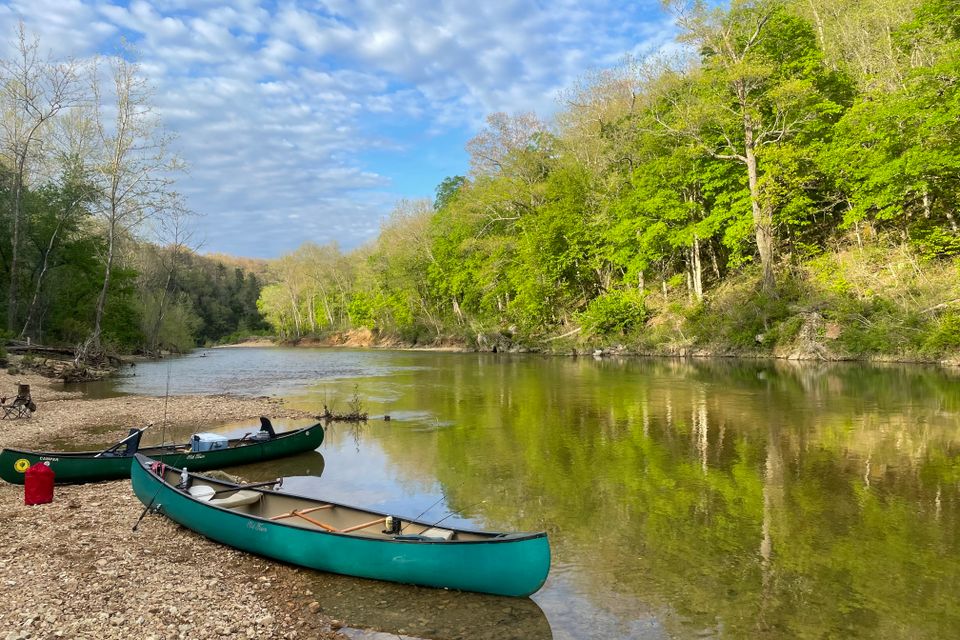
In addition to floaters’ rights to be on gravel bars, there is the continuing issue of public access to put-in and take-out points. On the federally protected sections of the Current, Jacks Fork and Eleven-Point, there are many designated access points. On some larger streams, such as the James, Niangua, and Gasconade, public accesses are owned and maintained by the Missouri Department of Conservation. But on most other Ozark streams, accesses, even on heavily floated streams, are primarily “historic”—places people have traditionally used as launching or pick-up points.
Public accesses are often headaches for agencies. Infrastructure is subject to flooding, a real problem for maintaining boat ramps and toilet facilities. Most accesses are unmonitored and unmanned, so have continuing problems with trash, vandalism, illegal fishing and trapping, and criminal trespass. Many landowners living near problem accesses would like to see them closed to the public.
As a result of these problems and landowner concerns, more and more accesses are being closed. A recent case in point is the historic access on Bull Creek at Round Mountain Road. When the county completed a new high bridge across Bull Creek, replacing the old “slab” bridge, a new fence was erected along the road, effectively ending public access to the traditional swimming hole and boat launch area.
Shutting off public access to rivers indirectly causes other problems. People tend to protect rivers they know, use, and love, even if locals have no interest in river protection. Closing rivers off from the public may silence an otherwise effective constituency for river conservation and advocacy. On the other hand, unmanaged and unattended accesses frequently attract “party crowds” and derelicts who can turn locals against all users, including boaters, fishermen and summertime swimmers.
With the surge in kayak purchases, more people are floating these days. The more people who float, the more accesses we need. But the more problems accesses create, the more people will try to close them. So, what is the solution? There is no easy one. The Conservation Department has attempted to layer more oversight through the public Adopt-An-Access Program. But what about the hundreds of historic accesses? Who will take care of them? Some groups are fighting to keep all accesses open, but this won’t solve the other problems.
It may be time to think about another model for public stream access. In my opinion, to reduce problems on routinely floated streams, accesses must be monitored and managed, somehow. One possibility is to use the “buy-protect-sell” model for public access. For this to work, there would need to be a large ($10 million, say) pot of money, perhaps from a conservation-minded donor, to establish a “conservation investment” fund. This interest-earning account would be used to buy property at an access from a willing seller or sellers.
Let’s say we were able to buy ten acres around a well-used access. A conservation group would then repair stream damage such as eroding banks or loss of trees in the riparian zone. A fenced access drive, parking lot and boat launch area would be constructed, along with a pit toilet, perhaps. A conservation easement would be placed along the river and around the parking lot and drive, say three acres in all. The remaining seven acres could then be sold to a private buyer, who could use the land for any legal purpose—building a home, for example.
Proceeds from the sale of the land would then go back to help replenish the “investment” fund. Any reduction between the original buying price and the selling price caused by the attached easement could be offset by a separate, smaller “philanthropy” fund, set up by conservation-minded people who are not expecting a return on their money.
Ideally, the access would be overseen on a daily basis during the recreational season, perhaps by a paid local landowner. There would be provisions made for regular trash service and onsite toilet pump-outs. There could be a day-use fee or overnight parking fee collected at the gate to help offset management costs. Users could get a temporary code for the locked gate after paying the fees.
Would it work? In today’s political climate, probably not. As an avid floater, I really want to be able to keep floating rivers that don’t have developed accesses. But that ability will depend largely on the courtesy and thoughtfulness of river users, who haven’t always demonstrated the best behaviors. As far as possible, boaters will have to try to stay on good terms with riverside landowners. And getting to know landowners at access points is always a good idea.
It’s a shame we have to deal with the down sides of public access. But it’s a reality that must be faced if we wish to ensure our future right to float. Surely there are ways to protect the rights of both riverside landowners and legitimate river users. Our wonderful Ozark streams are too precious to let slip from our grasp.